

Mancala games

 다운로드
다운로드  애플리케이션 설명
A two-player strategy board game
Mancala refers to a group of two-player, turn-based strategy games. They are played using small stones, beans, or seeds, which are moved around rows of holes or pits carved into the ground, a board, or another surface. The typical goal is to capture all or a specific set of your opponent's pieces. (Wikipedia).
The mancala family includes numerous games, such as Oware, Bao, Omweso, and others.
This is an implementation of several mancala games, including Kalah, Oware, and Congkak.
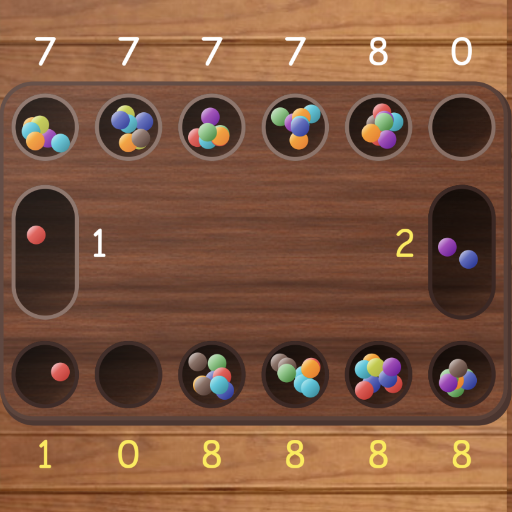
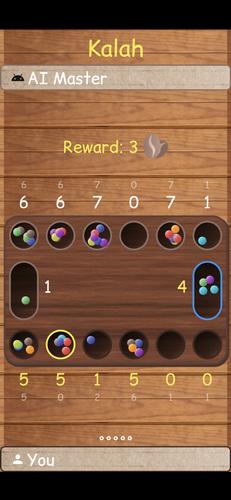
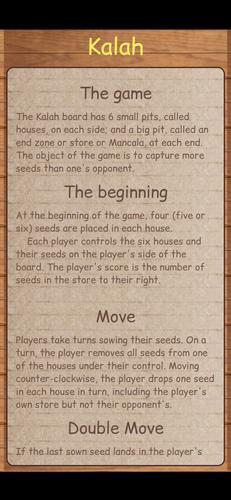
The game includes a board and a quantity of seeds or counters. The board features six small pits, known as houses, on each side, plus a larger pit, called an end zone or store, at each end. The objective is to capture more seeds than your opponent.
Kalah rules:
- At the start of the game, four (or five to six) seeds are placed into each house.
- Each player controls the six houses and their seeds on their own side of the board. A player's score is determined by the number of seeds in their store on the right.
- Players alternate turns sowing seeds. On a turn, a player picks up all seeds from one of their houses. Moving counter-clockwise, they drop one seed into each following house, including their own store, but not the opponent's store.
- If the final seed sown lands in an empty house the player owns, and the opposing house contains seeds, both that last seed and all seeds in the opposite house are captured and placed into the player's store.
- If the last sown seed lands in the player's own store, they earn an extra move. There is no limit to the number of consecutive moves a player can make in one turn.
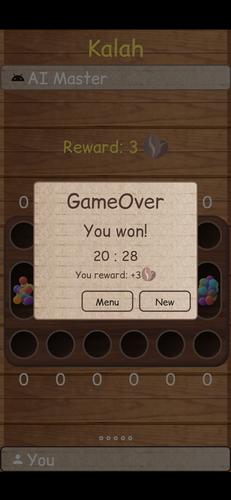
- When a player has no seeds left in any of their houses, the game finishes. The other player collects all remaining seeds into their store, and the player with the most seeds in their store wins.
Oware rules:
- To begin, four (five, or six) seeds are placed in each house. Each player controls the six houses on their side. The player's score is the number of seeds in their scoring house on the right.
- On a turn, a player takes all seeds from one of their houses and sows them by dropping one seed into each subsequent house counter-clockwise. Seeds are not sown into the scoring houses or back into the starting house, which is left empty. If a house contains 12 or more seeds, it is skipped during sowing, and the 12th seed goes into the next house.
- Capturing happens when a player's final sown seed makes an opponent's house total exactly two or three seeds. This captures the seeds in that house. Consecutive captures occur if the preceding seeds also brought opponent houses to two or three seeds, continuing until a house is encountered that does not have two or three seeds or does not belong to the opponent. Captured seeds go to the player's scoring house.
- If all of the opponent's houses are empty, the current player must choose a move that provides the opponent with seeds. If no such move exists, the player captures all seeds remaining on their own side, ending the game.
- The game ends when one player has captured over half of the total seeds, or if both players have captured exactly half (resulting in a draw).
What's New in the Latest Version 1.4.1
Last updated on Aug 6, 2024 - Bug fixes
스크린샷
 리뷰
댓글 게시+
최신 게임
더+
리뷰
댓글 게시+
최신 게임
더+
-
 Ni en pedo, bueno...en pedo si
판자 丨 43.9 MB
 다운로드
다운로드
-
 Goose Game Multiplayer
판자 丨 14.5 MB
다운로드
-
 Ludo Superstar
판자 丨 138.8 MB
다운로드
-
 Adult Sexy Coloring Games
판자 丨 55.4 MB
다운로드
-
 Halloween Witch Coloring Games
판자 丨 64.4 MB
다운로드
-
 Ludo League
판자 丨 4.3 MB
다운로드
비슷한 추천
더+
주요 뉴스
더+
-

-
 Infinity Nikki: 시즈폴렌을 얻는 방법
Jan 15,2025
-

-
Battlefield 6 Targeting FY2026 릴리스
Feb 19,2025
주제
더+
인기 게임
더+
-
1

Liars Bar Game - Liar's Games43.4 MB
궁극적 인 블러 프와 스터테기 게임 : My Liar 's Bar를 경험하십시오! 이 거짓말 쟁이 주사위 게임은 클래식 주사위 게임 플레이와 끝없는 재생 가능성을위한 흥미로운 미래 업데이트를 혼합합니다. 생생한 바 분위기 내에서 도전적인 AI 상대와의 솔로 또는 4 인 경기에서 자신을 도전하십시오. 키 FEA
-
2

Project Sekai KR1.07M
프로젝트 세카이 KR에 오신 것을 환영합니다! 게임을 다운로드해주셔서 감사합니다. 5월 20일 12시 정식 출시를 준비하세요! Project Sekai는 진정한 마음을 찾을 수 있는 곳입니다. 이 게임은 음악을 사랑하는 다섯 팀의 소년 소녀들이 우연히 오리기가 만든 가상 세계에 들어가게 되는 이야기를 담고 있습니다.
-
3

Jeet and Win Bonus Game12.10M
슬롯 게임을하는 아드레날린 러쉬의 팬이라면 Jeet에 뛰어 들어 보너스 게임을 이기고 싶을 것입니다. 이 앱은 스릴 있고 매력적인 게임 플레이로 논스톱 엔터테인먼트를 제공합니다. 멋진 그래픽은 시각적 매력을 향상시킬뿐만 아니라 APAR을 설정합니다.
-
4

Go Baduk Weiqi Pro90.00M
최고의 바둑 앱 프로바둑 GAME을 소개합니다. 모든 바둑 매니아를 위한 최고의 앱 프로바둑 GAME으로 지금까지 경험하지 못한 바둑의 세계를 경험할 준비를 하세요! 이 앱은 기술 수준에 관계없이 편안하고 몰입도 높은 게임 경험을 제공하도록 설계되었습니다.
-
5

친구 나 가족과 즐길 수있는 재미 있고 매력적인 카드 게임을 찾고 계십니까? 오프라인 도미노를 더 이상 보지 마십시오 -2019! 이 게임은 양쪽에 0-6 숫자가있는 28 장의 카드를 특징으로하므로 몇 시간의 엔터테인먼트에 쉽게 배우고 완벽하게 배우기가 완벽합니다. 이 고전적인 ST 게임에서 최대 3 명의 친구에게 도전
-
6

Lucky Machine3.90M
운이 좋은 기계의 럭키 머신 세계로 들어가십시오. 이 최첨단 앱은 상금의 스릴을 모바일 장치로 직접 제공하여 운이 좋은 신규 이민자들이 주장 할 수있는 다양한 게임 상을 제공합니다. 당신과 마찬가지로 전기 분위기에 몰입하십시오
7.02MB
다운로드24.3 MB
다운로드161.2 MB
다운로드52.5 MB
다운로드18.8 MB
다운로드93.6 MB
다운로드